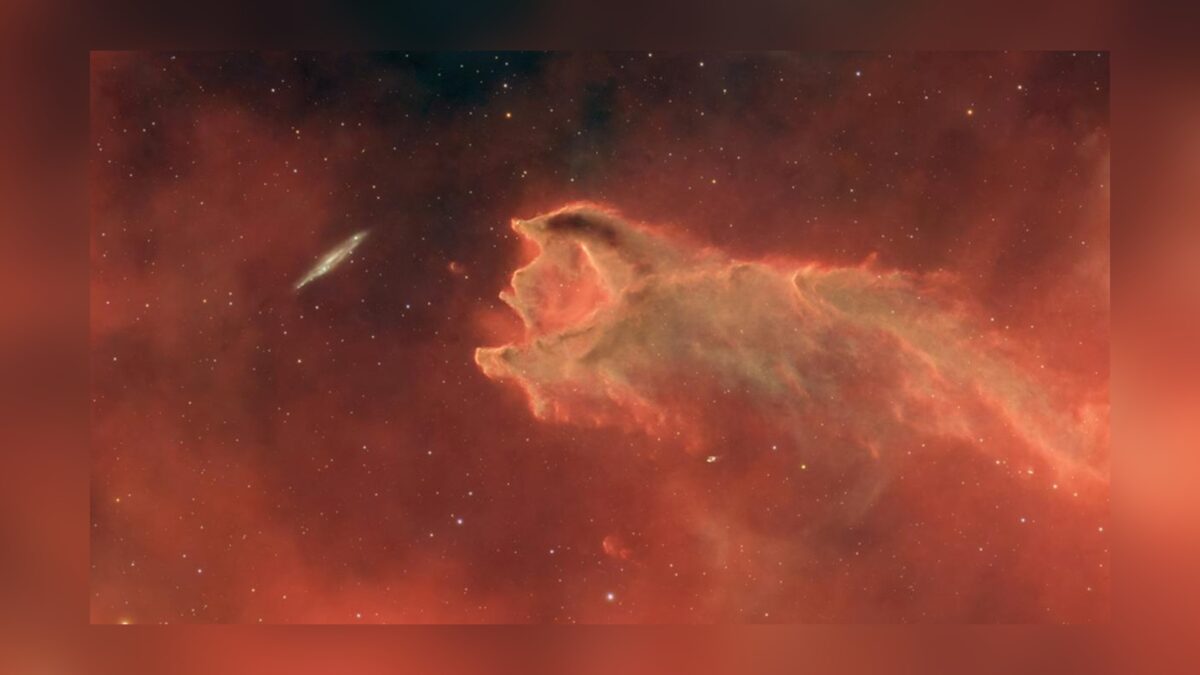
Located 1,300 light years from Earth in the constellation Puppis, lies the nebula known as ‘the Hand of God’. This stunning image was captured by astronomers at the Cerro Tololo Inter-American Observatory, using the Dark Energy Camera (DECam) on the Víctor M. Blanco telescope in Chile. Although it was first identified in 1976, its strange shape continues to fascinate the scientific community.
The cometary globule CG 4, which is part of this nebula, resembles a devouring head, pointing towards the galaxy ESO 257-19, located over 100 million light years away. Recently obtained images show a reddish glow of ionized hydrogen, highlighting its structural complexity. According to the National Optical-Infrared Astronomy Research Laboratory (NOIRLab), CG 4 belongs to a subclass of gas and dust clouds that exhibit comet-like characteristics.
The study of this nebula has revealed details such as its head measuring 1.5 light years and a tail extending about 8 light years. These dimensions are relatively small compared to other similar structures. Astronomers propose two theories regarding the formation of this cosmic colossus. The first suggests it was altered by the explosion of a nearby supernova, while the second posits that stellar winds and radiation pressure from massive stars have shaped its appearance.
For more information on space explorations, you can read about NASA’s Artemis II mission.